
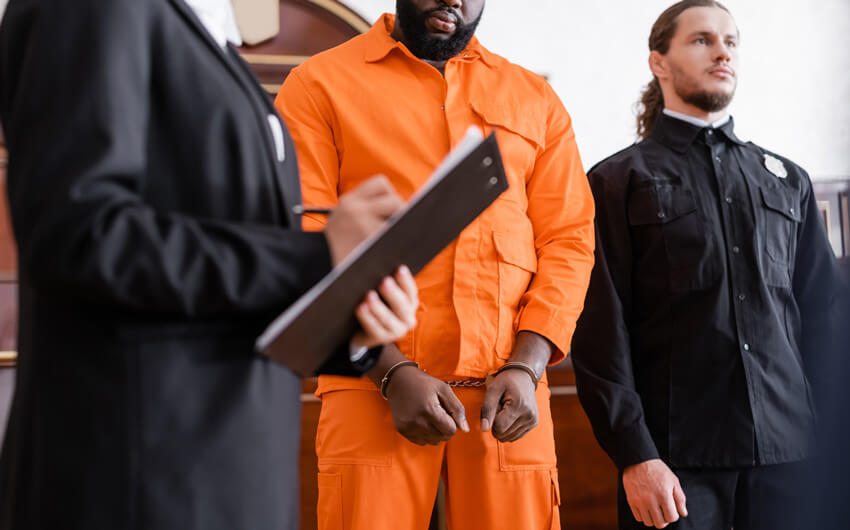
What to Expect in a Federal Criminal Prosecution

The Council on Criminal Justice reported a huge decrease in violent crime in the 30 cities that provided comparable mid-year data for 2024 and 2025. Specifically, homicides in 2025 declined by 17% compared to the previous year.
According to Sumter federal crime lawyer Garryl L. Deas, an understanding of the federal criminal justice process is very important if you’re facing criminal charges. The whole procedure moving from the first inquiry to the indictment is extremely important and full of challenges. You will face court proceedings such as arraignment and pre-trial, necessitating a constant focus on your legal strategy.
Let’s examine the things you can expect when you undergo a federal criminal prosecution.
The Investigation Phase
If you happen to be investigated for a federal offense, it is very important to grasp the steps in this process. The FBI and IRS are some of the federal investigative bodies that normally depend on proof coming from a variety of sources like wiretaps, interviews, and subpoenas, among others.
Your activities and connections will most certainly be under a magnifying glass and scrutinized very closely. It is necessary to recognize that the agents might aim to have a dialogue with you so as to extract information. Speak with care, since whatever you utter may be and will be employed in a negative way against you.
The most prudent option is to straightaway take the help of a lawyer who will support you in this very difficult position. Your guide will accompany you along the journey, explaining your rights and equipping you for different possible scenarios.
Understanding Federal Charges
It is highly likely that you will be subject to federal charges after the probe wraps up, which could have a grave impact on your life
Very often, federal crimes are felonies, which means that they will probably entail harsher consequences than crimes at the state level. According to felony lawyer Christy E. Draper, a first-time felony conviction might entail one of the harshest punishments: a long prison sentence of up to several years or even decades.
Only the very worst crimes are subject to federal court procedures, which are done by the US Attorney Office. These federal crimes include drug trafficking, fraud, and illegal firearm possession, among others. You can expect severe punishments for the conviction of these crimes, including huge fines, life imprisonment, and a permanent criminal record.
Knowing the charges against you gives you an edge in making a defense strategy, as every crime has its own distinct elements. You need to be aware of the weight of the penalties and whether you face a felony or a misdemeanor charge.
A proficient lawyer’s presence during your stay is a non-negotiable condition. They need to have the intellectual capacity to let you know about your rights, the real situation against you, and what might come in the future for you in such a way that you will be absolutely prepared to deal with the issue.
Arraignment Process
The arraignment is a really major step in the case against you in the federal court system. A judge will be the one to hear you at this hearing. They will read the charges out to you in a formal manner. After that, you would be allowed to plead guilty, not guilty, or no contest.
You must realize that this part of the process is the very first occasion for you to react to the charges. The judge might inform you about your rights and, depending on the circumstances of your case, the option of bail. You may be released on your recognizance or bail.
Typically, the arraignment occurs almost immediately after the arrest. This time can serve as a period for you to think over the difficulties that you will have to confront in the court system. If you have a competent lawyer by your side to assist you during this very important period, you will be able to go through the process more easily.
Pre-Trial Procedures
Once you have pleaded at the arraignment, the pretrial procedures will be the beginning of the next phase of your federal criminal prosecution.
Your attorney will commence gathering proof, questioning witnesses, and filing necessary motions at this point. You might also witness the exchange of discovery documents wherein the prosecutor reveals the evidence that they will be relying on against you.
Your lawyer could very well put forward a trial plan during pretrial conferences to the judge and the prosecution.
Be fully prepared for the hearings that might occur. One such occasion is the motion to suppress, which may render certain evidence inadmissible in the trial due to its legal basis.
Maintain contact with your lawyer, as each choice you make will have a major impact on your case’s outcome. Don’t wait for updaters but rather be active and involved since your future is on the line.
Plea Negotiations
Plea bargaining is often considered a necessary part of federal criminal trials, giving you very strong leverage over your future and presenting several issues for debate. Conversations between your lawyer and the prosecutor about your case may result in a lower charge against you or a lighter sentence.
It is even more important than ever before, if that was ever the case, to be in full possession of both your alternatives and the respective consequences. Your lawyer will point out the weaknesses of the state’s case, assess the risks of losing in court, and finally, come up with a settlement that is the most advantageous for you.
Plea bargaining should not be interpreted as admissions of guilt but rather as a clever tactic for managing the uncertainties of a courtroom trial. You will always have the right to present your questions and concerns throughout the entire process.
You are the only one who gets to decide whether you will accept any plea deals, but you look at them from every perspective before agreeing.
Trial Proceedings
Once your federal case trial is scheduled, be prepared for the systematic procedure that can significantly affect the outcome.
Jury selection is the first trial step. The judges are to cautiously ask questions, and the aim is to have a non-partisan group settled in the jury box. After that, the opening statements of each party are their body, which contains a brief glimpse of their arguments.
The prosecution presents its evidence and provides witness testimonies first, trying to eliminate any uncertainty regarding your guilt. The defense then offers its evidence and brings its witnesses, trying to weaken the prosecution’s case.
It is the jury that will be the one to go to the deliberation room to confer and reach a verdict after both parties have been presented and the closing arguments heard.
Your lawyer will be with you all the time during this court process. They will see to it that you are always informed about the situation. Keep your mind sharp and trust the legal strategy that is set by your counsel.
Sentencing and Appeals
Once the trial concludes, the center of attention changes to the phase of sentencing, where the judge is asked by all parties concerned to announce a penalty that, besides other things, considers the past offenses of the defendant and is also proportionate to the present one.
You can present your argument backed up with reasons that could be considered trivial but might have a bearing on the judge’s ruling.
Once the sentence has been pronounced, you may be allowed to appeal in case you think that the trial or the sentencing contained any legal errors.
Moving forward with the appeal process means that a notice of appeal has to be filed and briefs prepared, which will subsequently be forwarded to a higher court.
Be aware that making an appeal can be a time-consuming and complex procedure that demands very strong legal reasoning.
It is absolutely important that you are aware of your rights and of the options that are available to you during this time, as that could have a very substantial effect on your future.