
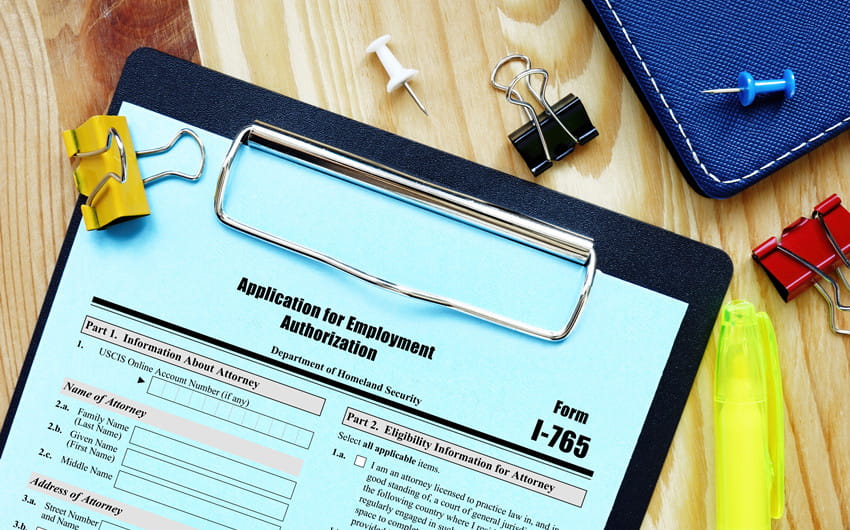
The Bridge to Your American Career: A Strategic Guide to Filing Form I-765

For many foreign nationals, the most significant barrier to a successful life in the United States isn’t just maintaining legal status—it’s the ability to work and contribute to the economy. While some visas grant employment authorization automatically (known as “incident to status”), many others require a proactive request to the government. This is where Form I-765, Application for Employment Authorization, becomes a critical tool.
Successfully filing the I-765 results in the issuance of an Employment Authorization Document (EAD). This plastic, photo-ID card is the definitive proof you need to show employers that you are legally permitted to work in the U.S. for a specific period. Whether you are an international student, a spouse of a high-skilled worker, or an applicant for a Green Card, the I-765 is your bridge between having a visa and having a career.
Identifying Your Eligibility Category
The most common point of failure for an I-765 application is selecting the wrong eligibility category. USCIS uses a complex system of codes to identify who is allowed to work. You must enter the correct category code (e.g., “(c)(9)” for those with a pending Green Card) in Part 2 of the form.
Common categories for the Manifest Law audience include:
• Adjustment of Status Applicants (c)(9): For those with a pending I-485 application. This is often filed concurrently with the Green Card application to allow for “interim” employment.
• F-1 Students (c)(3)(A, B, or C): Specifically for Pre-Completion OPT, Post-Completion OPT, or the 24-month STEM OPT extension.
• H-4 Spouses (c)(26): For certain spouses of H-1B nonimmigrants who have an approved I-140 or are under an extension of stay beyond six years.
• L-2 Spouses (a)(18): While L-2 spouses are now considered “work authorized incident to status,” many still file the I-765 to have a physical EAD as secondary proof for HR departments.
The 2026 Processing Landscape
As of early 2026, I-765 processing times have shown significant variation depending on the eligibility category. However, the most common reason for an immediate rejection is submitting the wrong filing fee. Because these amounts vary drastically—for example, a standalone paper filing is $520, while an I-765 filed concurrently with an I-485 is typically $260—we strongly recommend using the official USCIS Fee Calculator to determine your exact total before mailing.
Avoiding the “RFE” Trap: Documentary Requirements
A Request for Evidence (RFE) is the single biggest contributor to administrative delays. To ensure your I-765 is approved on the first pass, your filing must include:
1. Proof of Eligibility: This includes copies of your underlying approval notices (like an I-797 for an I-140) or your school-endorsed I-20.
2. Identity Documents: A copy of your current passport biographical page and your most recent Form I-94 arrival/departure record.
3. Photographs: Two identical 2×2 inch color, passport-style photographs taken within the last 30 days. Many rejections stem from photos that are too old or do not meet strict USCIS specifications.
4. Prior EADs: If you have ever been issued a work permit before, you must include a copy of the front and back of that card.
Online Filing vs. Paper Submission
In 2026, USCIS has made great strides in its digital transition. Many I-765 categories are now eligible for online filing through a MyUSCIS account.
• The Benefit of Digital: Online filing provides immediate receipt notices, reduces the risk of “lost in the mail” scenarios, and features built-in error checking that prevents you from submitting a form with missing signatures or blank fields.
• The Paper Reality: Some complex categories or concurrent filings (where you are filing the I-765 alongside a paper-based I-485) still require traditional mail-in submissions to a USCIS Lockbox.
Conclusion: Taking Control of Your Career Path
The I-765 is more than just paperwork; it is the document that authorizes your financial independence in the United States. By carefully identifying your eligibility category, leveraging premium processing when available, and submitting a “decision-ready” evidence packet, you can minimize wait times and focus on what matters most: your professional growth.